

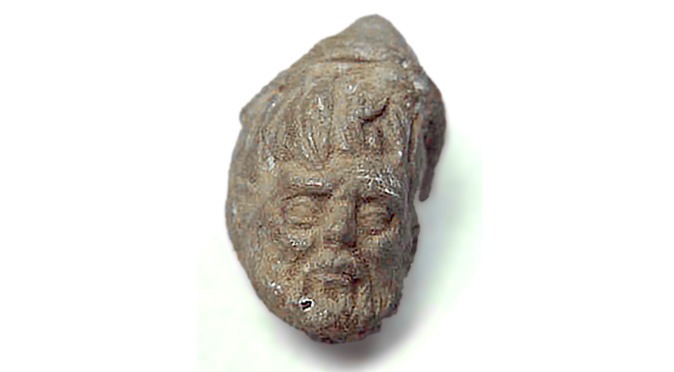
Could a small Roman-style head, found in a pre-Columbian tomb in central Mexico, compel historians to reconsider the limits of ancient Atlantic contact?
The Tecaxic-Calixtlahuaca Head remains one of the most provocative anomalies in American archaeology. Discovered in 1933 by José García Payón during excavations at Calixtlahuaca in the Toluca Valley, the artefact appears Roman in style, yet it was reportedly recovered from a sealed burial context dated to between 1476 and 1510. That combination alone is enough to keep the debate alive.
For the Gavin Menzies Research Foundation (GMRF), the importance of the object lies not in any claim that it settles the question of pre-Columbian contact. Rather, it highlights the value of anomalies in maritime history. Strange finds, especially those that sit awkwardly within accepted narratives, can expose the limits of current models and point towards overlooked forms of movement across the sea.
Discovery, Context, and Attribution
Calixtlahuaca was a major Matlatzinca centre later incorporated into the Aztec world. García Payón’s 1933 excavation uncovered a burial that appeared undisturbed beneath three intact floors within a pyramid structure. The burial assemblage belonged to the late post-classic period, and the context has been placed between 1476 and 1510. Among local pottery and obsidian lay a small terracotta head that looked entirely out of place.
The object’s significance rests on both context and style. If the burial was genuinely sealed and correctly dated, then the head was present in Mexico before the Spanish conquest. Yet the artefact itself does not look Mesoamerican. Its short wavy hair, beard, and naturalistic facial modelling have long suggested a Mediterranean, and more specifically Roman, origin.
In the 1960s, the head was examined by classical scholars including Bernard Andreae, who judged it consistent with Roman terracotta work from the second century AD, particularly the Severan period. This remains one of the strongest elements in the case. The argument is not simply that the head looks vaguely European. It is that its formal characteristics align much more closely with Roman imperial portrait traditions than with indigenous central Mexican ceramic styles.
If Andreae’s assessment is broadly correct, the head was made roughly 1,300 years before the burial in which it was found. That chronological disjunction is exactly what makes the artefact so difficult to dismiss and so difficult to explain.
Testing the Object
Unsurprisingly, sceptics have long suggested later intrusion, forgery, or contamination. The most important scientific response to those doubts came in 1995, when the head underwent thermoluminescence testing at the Max Planck Institute for Nuclear Physics in Heidelberg, at the Forschungsstelle Archäometrie.
Thermoluminescence testing estimates when a ceramic object was last fired. In this case, the result did not yield a precise date, but it did place the head firmly in the pre-modern period. The estimated firing range extended from the early first millennium BC to the 13th century AD. While broad, that range is highly significant. It excludes the possibility of a modern fake and does not support the idea of a post-conquest Spanish import.
The Max Planck result did not prove that Romans reached Mexico. What it did do was remove some of the simplest explanations. The head could no longer be waved away as a twentieth-century curiosity planted to provoke sensation.
The Atlantic Route Question
If the object is ancient and Roman in style, then the obvious question is how it crossed the Atlantic at all.
One possible explanation is accidental drift. Roman seafaring is usually framed in Mediterranean terms, but Roman merchant shipping also operated into the eastern Atlantic. The empire knew the Canary Islands, and the Canary Current, flowing south before feeding westward into the North Equatorial system, offers a plausible natural route towards the Caribbean and Gulf of Mexico.
This matters because it makes an unintended crossing conceivable without requiring a Roman voyage of discovery in any formal sense. A Roman merchant ship damaged in Atlantic waters, blown off course, or reduced to drift might, in theory, have been carried westward. An artefact from such a vessel could then have been salvaged on the coast, circulated through indigenous exchange networks, and eventually deposited inland at Calixtlahuaca centuries later.
The Roman merchant ship context is therefore relevant, even if one rejects sensational conclusions. Roman vessels were robust trading craft, capable of substantial cargo transport and long-distance sailing within the limits of ancient technology. The drift hypothesis does not depend on Roman navigators deliberately setting out for the Americas. It depends only on the maritime reality that ships, cargo, wreckage, and portable objects can travel in ways their owners never intended.
Why the Head Still Matters
The objections remain serious. There is still no securely documented cluster of Roman material from a pre-Columbian Mexican context to support the head. Nor do excavation standards from 1933 provide the level of certainty that modern archaeologists would ideally want. For many scholars, that is reason enough to remain cautious.
Yet caution is not the same as dismissal. The case persists because each explanation leaves something unresolved. A modern hoax sits uneasily with the thermoluminescence evidence. A colonial intrusion does not fit comfortably with the reported burial context or with the dating of the object itself. A Roman attribution fits the artefact’s style rather well, but opens a much larger question about transmission across the Atlantic.
For maritime history, this is precisely why the Tecaxic-Calixtlahuaca Head deserves attention. It illustrates that oceans do not only preserve the planned routes of empires and famous navigators. They also carry drift, salvage, loss, accident, and the unexpected movement of objects. Maritime history is not only the history of intended voyages. It is also the history of what the sea makes possible by chance.
Conclusion
The Tecaxic-Calixtlahuaca Head remains a small but powerful challenge to tidy historical boundaries. Discovered by García Payón in 1933, reportedly found in a sealed burial dated to 1476-1510, attributed by Bernard Andreae to the Roman Severan world of the second century AD, and tested in 1995 at Max Planck Heidelberg, it continues to resist simple explanation.
Whether the head ultimately proves to be evidence of accidental transatlantic transfer, an unresolved contextual anomaly, or something else entirely, its value is clear. It reminds maritime historians that anomalies matter. They force us to test assumptions, refine methods, and remain open to the possibility that the pre-Columbian Atlantic was less sealed than traditional narratives suggest.
That is why the Tecaxic-Calixtlahuaca Head still deserves careful study. Not because it offers certainty, but because it sharpens the questions that maritime history ought to ask.