

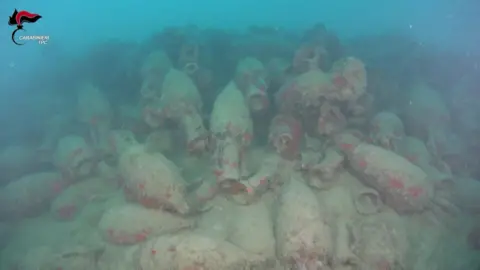
Image: Carabinieri via AFP, published by the BBC.
A newly discovered shipwreck off the coast of Sicily is offering an extraordinary glimpse into the scale and complexity of ancient maritime trade.
The wreck lies approximately three nautical miles from Mazara del Vallo, at a depth of around 46 metres. It is believed to date from the 2nd or 1st century BC, making it more than 2,000 years old. Most remarkably, the vessel appears to have been carrying hundreds of amphorae, the tall ceramic containers used to transport wine, oil, grain and other commodities across the ancient world.
The discovery was first made by fisherman and free-diver Giacomo De Mola, who noticed an unusual shape on his boat’s scanner. Expecting to find a large rock, he dived to investigate. Instead, he found what he described as “a vast expanse of amphorae” resting on the seabed.
De Mola later wrote that it was difficult to describe what it felt like to be “among the first humans, in nearly 20 centuries, to see that place again”. His words capture something central to underwater archaeology. A shipwreck is not simply an object from the past. It is a preserved moment, hidden beneath the sea until chance, technology or human curiosity brings it back into view.
A cargo preserved beneath the Mediterranean
The wreck is thought to be about 21 metres long and 6 metres wide. Specialist divers from the Carabinieri Cultural Heritage Protection Unit, working alongside Sicily’s Sea Superintendency and other authorities, are now documenting and protecting the site.
The amphorae are reported to include examples of the Dressel 1 type, widely associated with the transportation of wine during the late Roman Republic. Their concentration may eventually provide valuable evidence about the ship’s route, its cargo and the commercial networks that connected Mediterranean communities.
The wreck itself is significant, but the cargo may be even more revealing. Amphorae were not decorative containers. They were standardised, practical tools of commerce. Their shape, clay composition, markings and distribution can help archaeologists identify where they were made, what they contained and how goods moved between ports.
An apparently undisturbed cargo assemblage is therefore a historical time capsule. It can illuminate the movement of products, merchants, sailors and ideas across the sea. It also reminds us that trade was not an occasional activity carried out along isolated coastlines. It was a large-scale system requiring ships, navigational knowledge, technology, port infrastructure, finance and trust.
The sea as a highway
The Mediterranean is often described as a barrier separating communities. The archaeological record suggests something different. For thousands of years, it functioned as a transport highway.
From the Bronze Age onwards, ships carried metals, ceramics, foodstuffs, textiles and luxury goods between North Africa, Europe and the eastern Mediterranean. Gavin Menzies and Minas Tsikritsis suggest that the Minoans travelled even further afield to North America.
As Roman power expanded, the routes became part of an increasingly integrated commercial world. A ship sailing from Sicily was not operating in isolation. Its cargo belonged to a network that extended across many societies and political boundaries.
The Gavin Menzies Research Foundation’s work is concerned with this larger question: how far ancient and pre-Columbian mariners travelled, and what the surviving evidence can tell us about their capabilities.
The Foundation has previously explored discoveries that challenge assumptions about ancient seafaring, including a deep-sea Bronze Age wreck carrying hundreds of amphorae. That cargo, found far from the coast of Israel at a depth of approximately 1,800 metres, raised questions about how sailors navigated beyond direct sight of land.
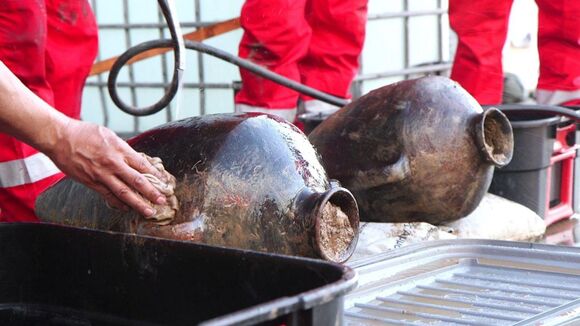
Related underwater discovery reported in the 1421 Foundation’s Explorer’s Journal. The image is not from the Sicily wreck.
The Sicily discovery belongs to the same broader conversation. It does not prove that Roman sailors crossed the Atlantic, but it adds to the evidence that ancient mariners were capable of organising sophisticated voyages across challenging waters.
From Roman cargoes to the Tecaxic-Calixtlahuaca Head
This is also where the wreck connects with the Tecaxic-Calixtlahuaca Head, which the Foundation has discussed as a possible Roman Imperial-period object found in Mexico.
The head remains controversial. Its proposed Roman attribution and its archaeological context have been debated, and one anomalous object cannot by itself demonstrate transoceanic contact. However, the question it raises is important: how should we assess an apparently out-of-place object when our understanding of ancient mobility is still incomplete?
The Sicily wreck gives us a securely maritime context in which to consider that question. It shows that Roman-era merchants possessed vessels, cargo systems and navigational traditions capable of regular long-distance movement. It also demonstrates how much evidence may still lie beneath the water.
One possible explanation for an isolated object in a distant land is the drift hypothesis. A vessel damaged by storms, carried by currents or forced far from its intended route could potentially travel much further than its crew planned. Such a journey would be accidental rather than evidence of a regular trade route. Nevertheless, the possibility matters because it encourages researchers to distinguish between deliberate exploration, unintended drift and later movement of objects.
The important point is not to claim more than the evidence allows. The Sicily wreck does not establish a Roman voyage to the Americas. What it does is make simplistic assumptions about ancient seafaring harder to sustain.
Why maritime anomalies matter
Every newly located wreck has the potential to revise the historical picture. The process begins with an anomaly: a shape on a scanner, a fragment on the seabed, or an object found in an unexpected archaeological context.
The right response is neither automatic acceptance nor automatic dismissal. It is careful investigation. As our research demonstrates, historical leads must be tested against archives, archaeology, scientific analysis and independent evidence.
This approach is central to the value of maritime research. The sea can preserve evidence remarkably well, but it can also scatter, conceal and distort it. Wrecks may be disturbed by currents, fishing equipment, marine life or earlier salvage. Objects may travel after a vessel sinks. Dating can be complex, and the identification of a cargo or artefact often depends on several lines of evidence being considered together.
That is why each discovery matters even before every question has been answered. A shipwreck provides a point of departure for further research. Its materials can be compared with objects from other sites. Its cargo can be studied alongside ancient records. Its location can help researchers reconstruct routes and understand the risks faced by mariners.
The sea has always been a highway of exchange rather than a permanent barrier. The wreck off Sicily makes that truth visible once again. Its amphorae preserve the practical details of an interconnected ancient economy, while the circumstances of its discovery remind us that vast parts of maritime history remain hidden.
For De Mola, the find was a personal moment of wonder. For researchers, it is an invitation to ask better questions about the movement of people and goods across the ancient world. And for everyone interested in maritime exploration, it is a powerful reminder that the next discovery may still be waiting in the depths.
Read the original BBC report on the Roman shipwreck off Sicily.