

The Discovery of a Chinese Imperial Seal in Northern Australia: Preliminary Report and Analysis
The Discovery of a Chinese Imperial Seal in Northern Australia: Preliminary Report and Analysis
Abstract
In May 2022, a copper-alloy seal bearing early Chinese inscriptions was discovered near Tortilla Flats, Northern Territory, Australia. Preliminary metallurgical and epigraphic analyses suggest the object predates any known modern or colonial Chinese presence in the region. The artefact, associated with Daoist deity worship, may indicate ancient maritime connections between Asia and northern Australia. This paper summarises the discovery, expert opinions, initial analyses, and recommendations for future study and preservation.
- What Has Been Found
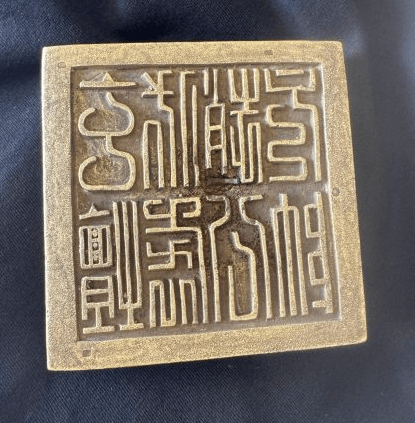
A square-shaped cast metal seal (90mm² 9mm Depth, 19.90 ounces) with eight Chinese characters and two side markings, believed to represent “a Daoist deity linked to wealth, protection, and navigation. The artefact bears the hallmarks of imperial-level craftsmanship, including a nine-fold casting method and complex copper-zinc alloy composition consistent with early high-temperature metallurgy.” - Who Found It
The seal was discovered by John Miltenburg. The initial Expert interpretation and contextual analysis were later undertaken by Ed Liu (Chinese scholar) and Ian Hudson and team, with external review and correspondence with Dr Luk Yu-ping, Curator of Chinese Paintings and Prints at the British Museum. - When It Was Found
The discovery occurred in early May 2022 during surface exploration of the wetlands area surrounding Tortilla Flats, Northern Territory, approximately 110 km south of Darwin. - Where It Was Found and in What Circumstances
The seal was recovered from wetlands heavily embedded in clay, located between two creek systems near Tortilla Flats. The location’s hydrological conditions preserved the artefact by limiting exposure to air and corrosive elements. There is no evidence of modern habitation, trade, or military activity in the immediate vicinity that would explain the seal’s presence through known historical channels. - Where the Artefact Is Now
The seal remains in the custody of the discoverer and his research team pending formal classification, conservation assessment, and eventual submission to an approved cultural heritage repository or museum for long-term curation. - Expert Opinions
Dr Luk Yu-ping (British Museum): Confirmed the Such seals were used in ritual contexts, not as personal or administrative tools. Ed Liu (Chinese Scholar): Identified the text as connected to high-ranking Taoist rites. The precision of the casting and the alloy composition suggest imperial foundry origins, possibly from Tang, Song, or Yuan dynasties (7th–14th century CE). Geological Analyst John Taye Ajide: Reported that the alloy composition was “remarkable,” showing advanced metallurgical knowledge inconsistent with colonial or industrial contamination. All experts concur that the seal predates World War II and modern industrial casting technologies, supporting its classification as an ancient artefact. - Tests Conducted and Further Tests Recommended
Tests Already Conducted:
• Elemental Composition Analysis: – Copper (Cu): 66.9% – Zinc (Zn): 25.6% – Lead (Pb): 2.4% – Minor: Al (1.54%), Sn (1.51%), Mg (0.59%), Fe (0.76%), Si (0.17%) – Suggests a leaded brass alloy, consistent with imperial Chinese metallurgy.
• Microscopic Structural Review: Indicated multi-stage casting with fine-grain structure and minimal oxidation.
Recommended Tests:
1. X-Ray Fluorescence (XRF) – non-destructive verification of alloy composition.
2. Scanning Electron Microscopy (SEM) – for surface morphology and corrosion analysis.
3. Isotopic Lead Analysis – to trace ore source and possible Chinese smelting region.
4. Thermoluminescence (TL) or Metallurgical Ageing Studies – to determine approximate casting period.
5. Residue Analysis – to detect organic or ritual material traces. 6. Contextual Soil Sampling – to confirm authenticity of site deposition and eliminate relocation hypotheses.
Conclusion
The Tortilla Flats seal is a potentially transformative artefact in understanding pre-modern transoceanic interactions. If authenticated as pre-European, its existence in Australia implies early Chinese maritime reach or religious diffusion far beyond current historical models. Urgent preservation and rigorous interdisciplinary study are required to confirm its origins, cultural significance, and potential impact on the global history of navigation and protection, the ancient maritime world
© 2025 John Miltenburg, The Finders NT, Scooters Roost NT. All rights reserved.